Inside the Project: Alberto and Francesco Meda share their vision of the chandelier
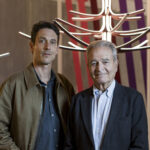
After reinterpreting the luminator — Chiaroscura — Alberto and Francesco Meda return to revisit another lighting classic for Foscarini: the chandelier.
After the interpretation of the historic Luminator designed by Pietro Chiesa in 1933, which led to the Chiaroscura lamp, Alberto and Francesco Meda rethink a lighting classic for Foscarini: the chandelier. Once again, they have worked with extruded aluminium, inserting the lighting elements inside the body of the lamp itself, while also indulging in a decorative divertissement obtained impeccably in a game of interlocks between the light source and the support.
In your view, why did Foscarini ask you to collaborate on this project?
«Foscarini was undoubtedly seeking multiple hands and perspectives to be applied to the theme of experimentation with the archetype of the chandelier. With respect to the other designers involved (Francesca Lanzavecchia and Dordoni Studio, ed.), I think our force lies in the pursuit of innovation starting with the dialogue between materials and technologies, interpreting the tradition in a contemporary way, without disrupting its essence».
As designers what interested you about this project?
«We like to work on typologies that have remained constant in time. We did this with Chiaroscura, and the same is true of the chandelier, an object that has been infinitely studied and reinterpreted, but always with an approach based on decoration and the multiplicity of light sources, which was substantially updated only by Sarfatti with the 2097. Instead, we have chosen to approach the challenge from an opposing vantage point».
Which one?
«We began by asking ourselves where contemporary lighting technology would lead us, namely the new opportunities offered by LEDs, which allow you to work on the quality of the light and its emission. Within the typology of the large lamp at the centre of the room, we wondered what might be the most essential form the LEDs would permit us to achieve. This took us to the idea of the arm with an LED strip, the starting point of the design».
Discover Asteria
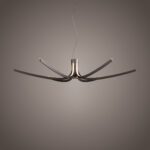
Discover Asteria
What is the key of interpretation with which to grasp the innovative impact of ASTERIA?
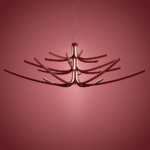
«The design strength of ASTERIA lies in the close integration between structure and light. As we were saying, the basis of the design is the arm, in extruded aluminium with a V-shaped section, with a vertical short side and a longer side that extends horizontally, in a curve. The light is emitted by an LED strip set into the upper part of the arm and covered by a transparent film, which imperceptibly overlaps at the edges and allows the light to slightly emerge. This detail makes the light source perceptible, even when the vantage point is from below, or from the side. The arm, which functions both as structure and as a diffuser, is connected to a central vertical cylinder. Six arms form one level of the chandelier, with a maximum of three levels stacked in a staggered arrangement.
When it is turned on, ASTERIA emits light in multiple directions: upward, radially thanks to the overlay of the levels, and with a slender, almost graphic luminous line, where the LED emerges slightly from each single arm. Furthermore, if suspended over a table, the lamp provides direct light, thanks to another source placed in the lower part of the central cylinder».
Narrated in those terms, it would seem to be a modular chandelier. Is that the case?
«Yes, each level can exist independently as a suspension lamp. The modular character exists, then, though to maintain a certain coherence the various configurations will be offered by the company, to achieve a particular aesthetic and functional variety».
How did you arrive at such an essential redefinition of the chandelier?
«We were seeking for an evolution of the concept. We worked on the arm as the central element and we inserted the light in the structure. Initially we wanted to create a more rigid, linear structure, but then we realized it was too cold. So we introduced curves and a more dynamic arrangement of the arms, to make the design more harmonious and contemporary».
Developing the project together with Foscarini, has there been a significant evolution with respect to the initial concept?
«Yes, above all in the idea of ‘dishevelling’ the composition to avoid an overly rigid look. This was the contribution of the company, who wanted to give greater dynamism to the object».
How do you understand when a project has reached the right balance between rigor and softness?
«It is a process of continual refinement. At the start there is always a risk, but you gradually get feedback from the experimentation, and you begin to see if the solution works. This is why it is so important to have an affinity between the designer and the company».
What is the meaning of being contemporary today?
«It means making simple things, things that have been resolved from a constructive viewpoint, where the technics and technologies that have been utilized to achieve the result are not on display. Therefore it means creating objects with less connotation, that precisely for this reason can last in time, because they are not subject to passing fashions».
But fashions exist. Is that a problem?
«Yes, there is the risk of excessive standardization. Decades ago, the distinctive factor of Italian companies was the ability to evolve, to develop pieces of knowledge that other people could inherit and take forward. Today this is very rare and the consequence is that what is displayed at trade fairs is all very much the same: when something works on the market it immediately becomes a template to be repeated, with or without variations. The same thing happens with the classics, to which companies infinitely return because they are safe and commercially effective».
Are lack of innovation and attachment to the past a problem only for design lovers?
«We think this will become a problem for companies. Above all the small or young companies, which do not have a heritage on which to draw, so instead they copy the forms and flair of the classics, rather than inventing something personal and meaningful. When the market becomes saturated, they will have a problem».
Alberto, you have said that design adds a piece of knowledge to what already exists. How can you pursue this objective?
«You have to be curious about scientific and technological developments, without paying homage to technology as an end in itself. Design has to know how to grasp the innovative value of technology and to transform it into a functional and aesthetic advantage. For example, getting back to the theme of reinterpretation of the classics, it is an exercise that makes sense if you can add what is offered by research on more sustainable materials to the original project, a sector where I see that many companies are effectively making an effort».
How do you see the future of lighting?
«The OLEDs could represent a true revolution. These are point-by-point light sources, which although they are still relatively costly offer great possibilities for designers, thanks to their ability to emit light from a flat surface. This surface can even be flexible, like fabric, opening up unusual and varied scenarios that undoubtedly deserve to be explored».
Light that is not just function, but presence, character, and expression.
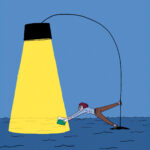
In the small, theatrical stage sets of Spanish illustrator and Wes Anderson collaborator Javi Aznarez, a story rich in detail, humanity, and subtle, biting irony comes to life around every Foscarini lamp.

In the hands of multimedia artist David Szauder, Foscarini’s lamps awaken, dance, and transport us elsewhere. In a Ballet Mécanique that is at once classic and radically contemporary.

Under the light of Foscarini lamps, stories are born. These are the moments when light stops being decor and becomes Home.

For What’s in a Lamp?, Frelly builds a series of images in which each Foscarini lamp becomes a hat to be worn, turning design objects into living presences that reshape the space around the people who wear them.
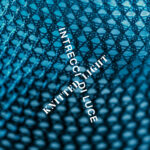
For Milano Design Week 2026, Foscarini presents a series of research projects on the interaction of light and 3D knitting, at Foscarini Spazio Monforte. An exploration that spans materials, processes and production techniques to open up novel possibilities for shedding light.

Silent images, domestic settings, a light that sparks unexpected possibilities. For What’s in a Lamp?, Marianna Tomaselli creates a series of illustrations in which Foscarini lamps become the starting point of a visual narrative, where light generates relationships, atmospheres, and subtle shifts in meaning.

Illustratore, animatore e storyteller Brian Rea entra nell’universo di What’s in a lamp? trasformando le lampade Foscarini in presenze vive, intime e silenziose. Un progetto dove luce e personaggi dialogano con delicatezza, sorpresa e immaginazione.
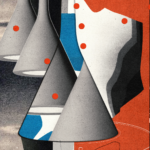
For the What’s in a Lamp? project, Italian artist Beppe Conti imagines lamps not simply as sources of light, but as instruments that reveal the invisible. In his digital collages, fragments and hidden layers emerge from the darkness, shaped by the light of Foscarini lamps into dreamlike spaces.

With his unmistakable style defined by essential shapes and bold colors Peter Grundy transforms Foscarini lamps into visual archetypes of the concepts and values that define the brand’s identity for the editorial project What’s in a Lamp?. An exercise in synthesis and vision that invites us to see light not only as a source but as meaning itself.

Francesca Lanzavecchia knows exactly what she wants: to design objects that never fail to make an impression. Not just a matter of aesthetics, but of that intense emotional resonance her projects attempt to set in motion. In an interview, she talks Allumette and Tilia, the two chandeliers she has designed for Foscarini.